

I’ve been fascinated for many years with Saint Brendan the Navigator. There are several levels to this. He’s in important figure in Christian history—a 6th century Irish Saint (recognized in both the Orthodox and Catholic churches) who, among other things, was an Abbot and a founder of monasteries. On a personal level, I believe he once helped me when I was hitchhiking on his feast-day (more on this below). There’s also fascinating lore about him undertaking a long ocean voyage in search of an earthly paradise. Some people think he may have crossed the Atlantic and landed in eastern Canada. There are many medieval variations on the story of his voyage, including such incidents as him serving Easter Mass on the back of a gigantic fish. On a pure literary level, fantastical ocean voyages involving saints and monsters (and Canada?) have a pretty strong appeal for me.
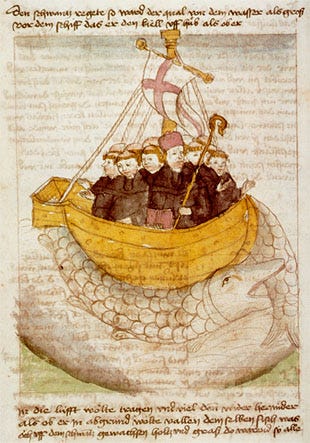

I decided recently I wanted to write a poem about Saint Brendan, so I started reading up on his life and the medieval accounts of his voyage. The process did result in one original poem, about my own experience with Saint Brendan while hitchhiking. This poem was recently published in Traces Journal (thanks to editor Maya Venters). The poem starts like this:
On the feast-day of Saint Brendan, I was standing on the shoulder
of Highway 1 outside of Winnipeg—the last upholder
of former rights of access to the common thoroughfare—
or that’s how I explained it to myself. I waited there,
my thumb jabbed out to catch a ride. Around me, swells of prairie
waved golden out into the morning—amber tides that carry
on westward to the Rocky Mountains, eastward to the Shield—
where worn-down nubs of rock bulge out, unevenly concealed,
beneath Ontario, and eastward out to Newfoundland,
where Brendan might’ve landed once. …
Read it in full at Traces Journal here.
In reading about Saint Brendan, I discovered a fantastic Middle English verse account of his voyage. It’s written in rhyming fourteener couplets, which is a form I’ve always loved, and has a great, wacky medieval energy. I got so preoccupied with this poem that I ended up translating the whole thing (around 20 pages). An excerpt from it was recently published in the Halloween issue of New Verse Review: A Journal of Lyric and Narrative Poetry (thanks to editors Steve Knepper and Zina Gomez-Liss). Here’s an excerpt of the excerpt:
One time, when they were sailing through a tempest, a prodigious
sea creature started chasing them. The thing was huge and hideous.
The beast spewed burning foam out from its mouth and nose. Each blast
sent reeking spume above the ship—so high it cleared the mast.
Ungainly as a house, the monster barrelled after them
astonishingly fast, the whole time belching brimstone phlegm.
The frightened monks cried to Saint Brendan—also to Christ Jesus—
“Please bring us help! That monstrous beast is just about to seize us!”
And when the monks had given up all hope of their survival,
another fish swam from the west and smote into his rival
with such sea-splitting speed that the great monster’s ghastly carcass
was ripped apart. Three fragments drifted down into the darkness.
The fish swerved through the sea and swam back swiftly westward. They
gave joyful thanks to Jesus as they watched it swim away.
Believe it or not, it gets wackier after this. Read the rest of the excerpt at New Verse Review here.
I’ve got some other pieces of the translation out for publication in other places, but I’m trying to figure out what to do with the translation as a whole. I’d love to hear what you think. How would you feel if you picked up my next poetry collection and it included a 20-page medieval translation like this? Is that too much? Is it better to just include smaller excerpts throughout the collection, like Emily Osborne did with her Norse translations in her collection Safety Razor? Or is it all just too weird and medieval?
I don’t normally publish poems on substack that aren’t already published elsewhere, but I’m going to share the opening section of my translation below. I’d love to hear what you think of it!
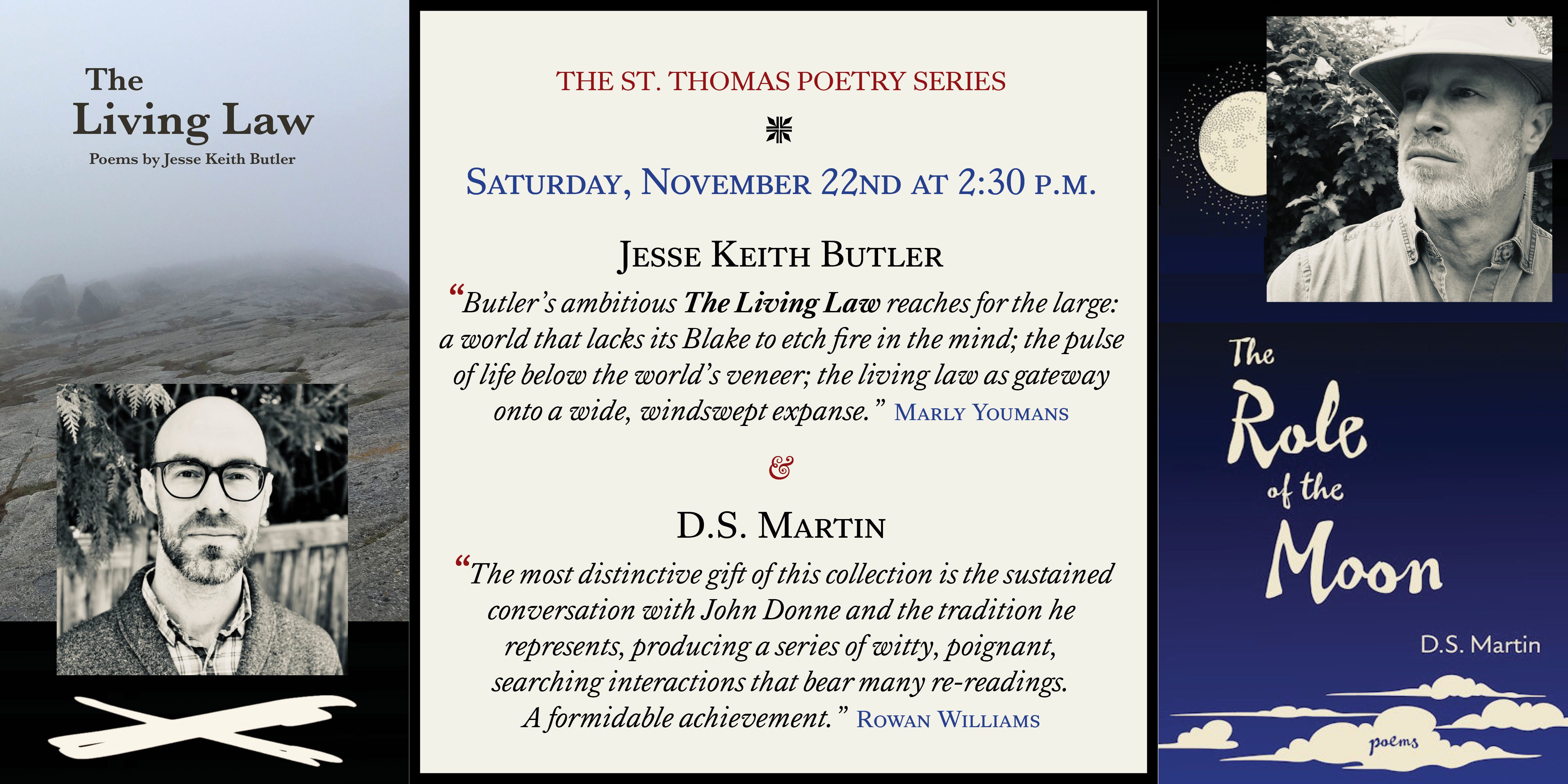
But first, a reminder of my upcoming reading in Toronto with D.S. Martin:
Now back to our regularly scheduled programming.
Here’s the first of six sections of my translation. The source text is the Middle English verse text from the 14th century South English Legendary. My translation is definitely not an academic translation. My focus was on preserving the form, story, and pacing of the original, and I took some liberties at the level of syntax in order to achieve this. I also had a lot of fun with the rhymes. There are a lot of curiosities here, like the fact that they sail eastward from Ireland—which makes no geographical sense but is very interesting in terms of liturgical symbolism. But anyways, here it is. Let me know what you think!
From “The Voyage of Saint Brendan”
Saint Brendan came from Ireland, on the known world’s farthest brim.
He lived a hard life as a monk—or so it’s said of him—
with many fasts and penances. He was the abbot of
a thousand other monks, and he ruled over them in love.
One day, another abbot came to them. It was apparent
this man had voyaged far in other lands. His name was Barynt.
Saint Brendan started asking him to tell where he had travelled
And all the wonders he’d seen there. The man simply unravelled
on hearing this. He gave a moan in answer to the saint.
He started weeping gaspingly, then fell down in a faint.
Saint Brendan took the holy man up in his arms, and spoke
his name, while tears ran through his beard. In time, the old man woke.
Saint Brendan said, “For pity’s sake! Please, father, find a way
to speak. You came here for our solace, not for our dismay.
Now tell us everything you saw—with none of this commotion—
when our Lord sent you far abroad, across the Sea of Ocean.”Now the sea that they call “Ocean” is the greatest sea. It’s curled
around the earth, and gathers all the waters of the world.
And so, this old man, Barynt, seemed to bolster up his courage
and, in a groaning voice, began to tell about his voyage.He told them then: “I had a godson. Mernoc was his name.
He was a monk—as we all are—and one of growing fame,
so that his heart led him to seek a place, quiet and still,
where he might live in solitude, and better serve God’s will.
And so, with my permission, he sailed off alone and found
a little island in the sea—a pleasant patch of ground—
beside that stony mountainside that’s very widely known.
That monk lived there so long beneath that mountainside of stone
that many other monks came there to join him, and to be
beneath his rule. As soon as I heard this, I went to see.
Meanwhile a vision came to him—the sweet Lord let him know
that I was coming, and that once I’d come we two must go
out on a journey. So we took a ship and traveled east
across the Sea of Ocean—there our torments hardly ceased.
We went so far toward the east that we arrived at last
in a place of heavy darkness, where the sky was overcast.
All through the day we were in darkness—clouds hung overhead—
until at last our gracious Lord had mercy, and he led
us out to see an island, and toward it our ship sailed.
That land shines brightly like the sun. There joy has never failed.“The land stood thick with foliage, and shone from every angle
with precious stones. The very sight of it would make you thankful.
Each bush was lushly flowering, each tree was lushly fruitful.
Outside of heaven, surely there’s no other land so beautiful.
Within that land we wandered, filled with joy, a long, long while—
although the time seemed brief. The land spanned out mile after mile.
At last we found a river that was clear and bright and wide
and swiftly flowed from east to west. We saw the other side
was much too far to cross. Uncertain, we just stood and glanced from
one side back to the other. Then a young man, kind and handsome,
came up to us and greeted every one of us in turn
by name—the proper names he’d never had a chance to learn.
He said: ‘Give thanks to Jesus Christ—for it is only right—
who’s shown to you his hidden things, and so much of his might.
This is that land that, when the world is ending, he will give
to all his righteous ones, and here they all will come to live
on that great day our Lord will separate the wheat and chaff.
He’s shown to you half of this land now. But the other half
is on this river’s other side. You can’t proceed past here.
And in this land you’ve lived now without food almost a year.
You didn’t eat or drink or sleep in all that time, nor did
you feel the heat or cold, or see the darkness. Our God hid
this land away from all the world, and all the light’s from him.
That’s why it’s always daytime here. This brightness doesn’t dim.
If only people hadn’t strayed away from God’s commands,
they and their offspring could’ve stayed in this, the best of lands.
But now you must go back to sea again. It isn’t granted
to stay here longer, though I know it feels like you’ve just landed.’“And so he brought us to our ship, and very kindly sent
us homeward, then was gone. We couldn’t tell you where he went.
He left against our will, and his departure left us very
distraught. Our ship sailed with good speed toward the monastery.
As soon as they could see us all the monks came in a throng
to meet us. They were quite upset that we’d been gone so long.
We told them all, with such great joy, how we’d been graced to stand
before the gates of paradise and in the promised land
preserved for all the faithful ones—to whom our Lord has vowed it—
where it is always daytime and the skies are never clouded.
‘Certainly,’ the monks all said, ‘We all can clearly tell
it’s true you’ve been to paradise—we know by your sweet smell.’”Saint Brendan, after hearing all this, stood in thought, unmoving.
He wanted to learn more of this. But first it must be proven
if doing so was what God willed for him, or if it wasn’t.
He went among his monks then, and he chose from them the dozen
he trusted most. He said to them, “I’m needing your advice.
I want to do a secret thing—to seek out paradise,
that promised land we heard about, and see if God would lead
us there. Is it your counsel to attempt so great a deed?”“Beloved father,” they all said, “You know that we forsook
our own wills, with our friends and other goods, the day we took
obedience to you. If this is what you will decide,
we vow to go with you and trust the Lord to be our guide.”And so they fasted forty days, did penances, and sought
God’s grace to undertake the voyage. Then Saint Brendan got
his monks to build a sturdy ship, to wrap it in strong leather,
and nail it firmly to the frame to fasten it together,
and then to paint the hides with pitch to make them watertight.
They went to all their brethren then, to take their leave the right
and proper way, departing in the name of our good Lord.
The brothers left behind were grieved to see them climb aboard.Then, when they were aboard the boat, two monks came on the shore
and begged to join the journey, if the boat could fit two more.
“You may,” Saint Brendan said, “But you’ll regret it. Mark me well—
before the end, one of you two will go alive to hell.”
Hi Jesse - it's so cool to discover you here. I knew you when you were just a sprout in Dawson City!
Very cool. I hope to read the rest of it sometime. There's one line where the foot might be more easily accommodated if you switched two words: "so that his heart led him to seek a place, quiet and still" tripped me up; you could make it, "so that his heart led him to seek a quiet place and still".