
How I'm a Sci-Fi Poet
July Poetry Update

Hi friends,
A lot’s been happening since my last update. The big news is that I’m now a Science Fiction Poet.
A few weeks ago, my poem “The Archive of Readerless Books” was published in Autumn Sky Poetry Daily. You can read the whole poem online here. Editor
describes my poem as follows: “Dystopian sci-fi meets present day meets rhyme (but often slant) in this poem’s narrative of persistence against futility.”Science fiction meets formalist poetry, you say? But wait. There’s more.
In late June, I had a weird dreamscape poem called “How I Am Here” published in On Spec: The Canadian Magazine of the Fantastic. Thanks to the mercy of alphabetical order, my name is even featured prominently on the very retro-feeling sci-fi cover.
Look at this thing. Isn’t it beautiful? It feels like a classic Asimov story.
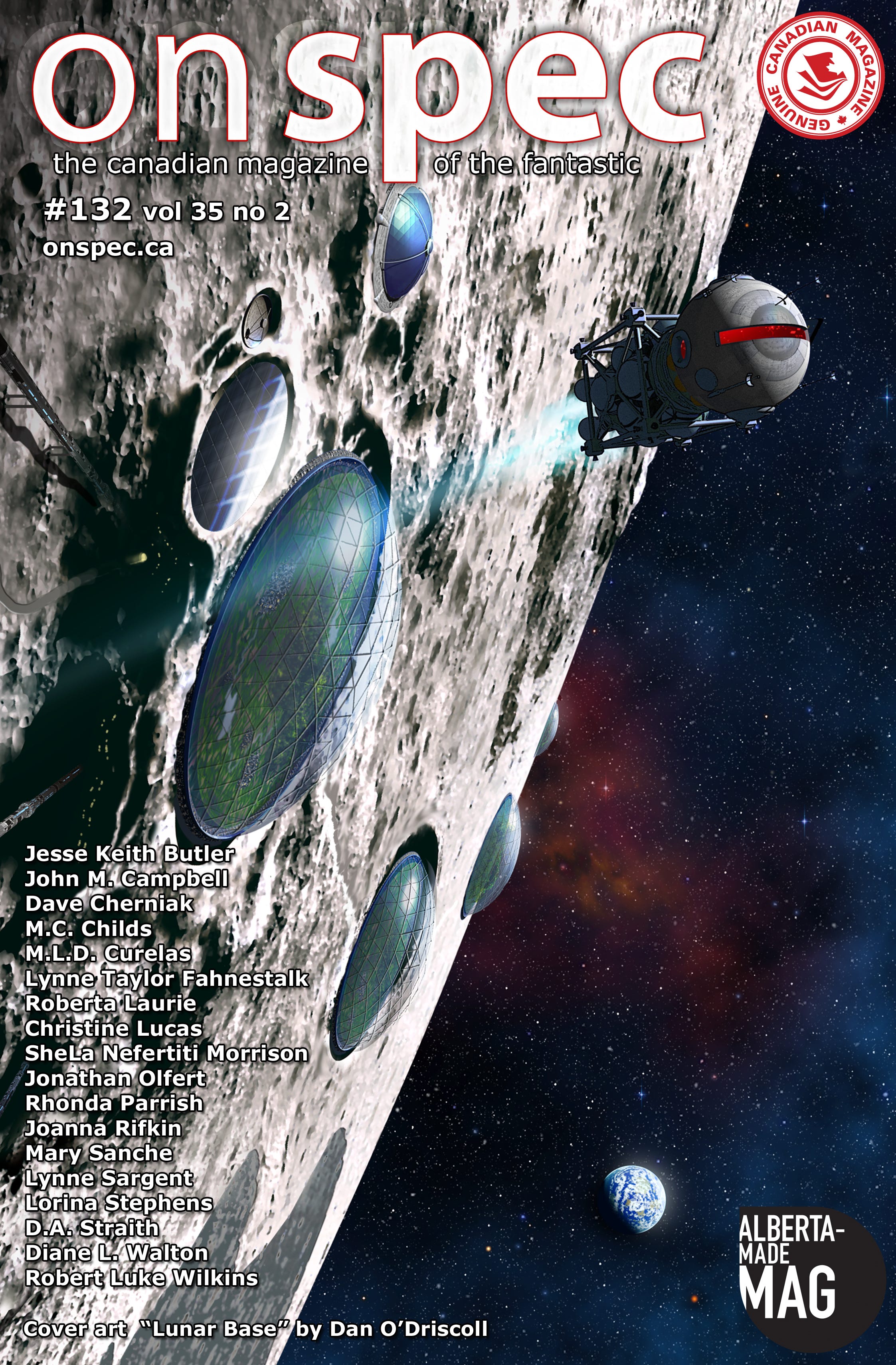
On Spec is paywalled (which I appreciate because it allows them to actually pay their authors), so I can’t share my full poem here. Pick up a copy—it’s worth your time. But here’s one stanza from the middle of the poem’s journey, which I think gives you a bit of the flavour:
I found myself at a waterfall
that gathered and gushed its vitriol
out over the edge, while singing of
the Bible, Dante, and Tarkovsky.
Its voice resounded, but softly, off-key.
And peering outward, aching with love,
instead of a river I saw an unbounded
ocean. I waited there, where the earth ended.
“The Bible, Dante, and Tarkovsky.” That’s a pretty good summary of where my head’s at these days.
As fortune would have it, I just had another poem about Tarkovsky published in Pulp Literature. (Pulp is also paywalled, but also worth your time. Thanks in particular to outgoing Pulp poetry editors
and .) This poem is called “The Solarists,” and is a bit of a love poem to my wife about the time I tried to show her Tarkovsky’s Solaris (which I really wanted her to see because it’s my favourite movie of all time). The poem begins:When I got you to watch Tarkovsky’s Solaris
for date night, and you fell asleep on the couch,
I wished I could say why I wanted to share this.
I know for you it was much to much . . .
So why did I want to share it? (Go read the poem for the proper answer to that question.) And why do I seem to keep writing poems about Tarkovsky? The answer to these questions also gets at the bigger question of what it means to me to be a science fiction poet.
For those of you who don’t know, Andrei Tarkovsky was one of the great 20th century Russian filmmakers, and Solaris is one of his masterpieces. Based on a science fiction novel by the also-great Stanislaw Lem, it’s an account of scientists trying to establish contact with a mysterious life-form, a living ocean encompassing an entire planet, which also seems to be trying to establish contact with them. Lem’s novel is basically a satire, dramatizing the incapacity of science to address the ineffable. Tarkovsky’s film is a fairly faithful adaptation, but with his trademark Orthodox mysticism he shifts the focus, making it more of a meditation on the encounter with the ineffable itself. And the film itself doesn’t simply dramatize that encounter, but invites us into it. In its lingering pace, in its lush cinematography, in the deep mystery of its landscapes, it draws us beyond mundane experience into something else.
It’s this effort to articulate an encounter with the ineffable that I find in some of my favourite poetry, and also in the best science fiction. In much of my recent poetry, I’ve been trying to move more directly into this territory. What does this look like? A lot like “the Bible, Dante, and Tarkovsky.”
recently described the thematic unity he’s noticed in my recent poems as follows: “Primordial and apocalyptic, ancient and futuristic, lots of ocean/water imagery, the way water destroys and shapes and renews.” That could be a description of Solaris, but it’s also a good description of the new collection I’m working on. I’m very close to a full draft of my second book. Stay tuned.
'I suspect the whole state apparatus
at this point is just run by machines.
They might use human language for status,
but they don’t need to know what it means.'
*
Loved it. Thanks for these!
Your brain is too big, or er, mine just imploded. What a mess.